|

How Khamenei Ruled 36 Years With Fear and Fire
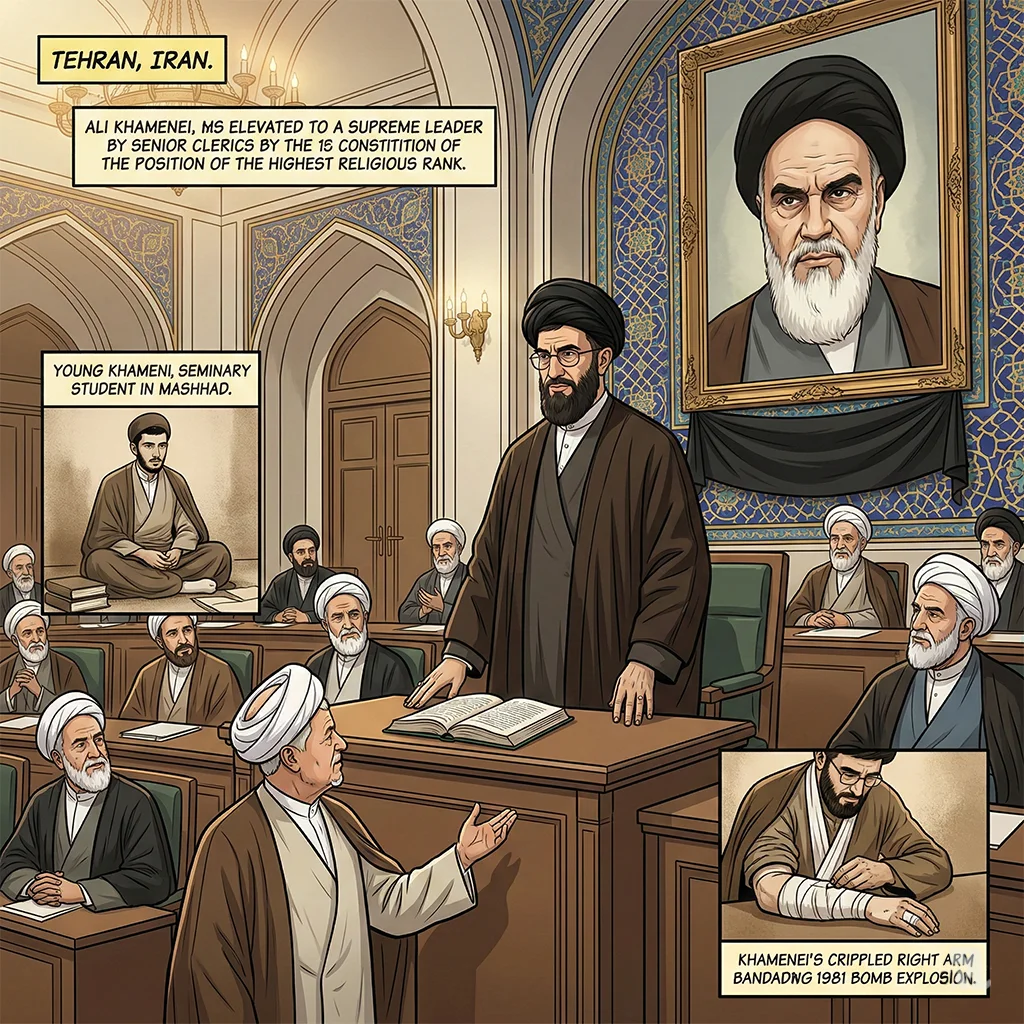
A depiction of the Assembly of Experts chamber in Tehran, 1989. A young Ali Khamenei, wearing a black turban and spectacles, stands at a podium with his injured right arm at his side. Behind him, a large portrait of the late Ayatollah Khomeini hangs beneath a black mourning banner. In the front row, a figure resembling Ali Akbar Rafsanjani gestures toward Khamenei. An inset shows a younger Khamenei as a seminary student, and another shows his arm being bandaged after a 1981 bombing.

Born in 1939 in Mashhad, Ali Khamenei rose through the revolution, survived a 1981 bomb that crippled his arm, became president in 1981, and in 1989 was made Supreme Leader despite lacking top religious rank.
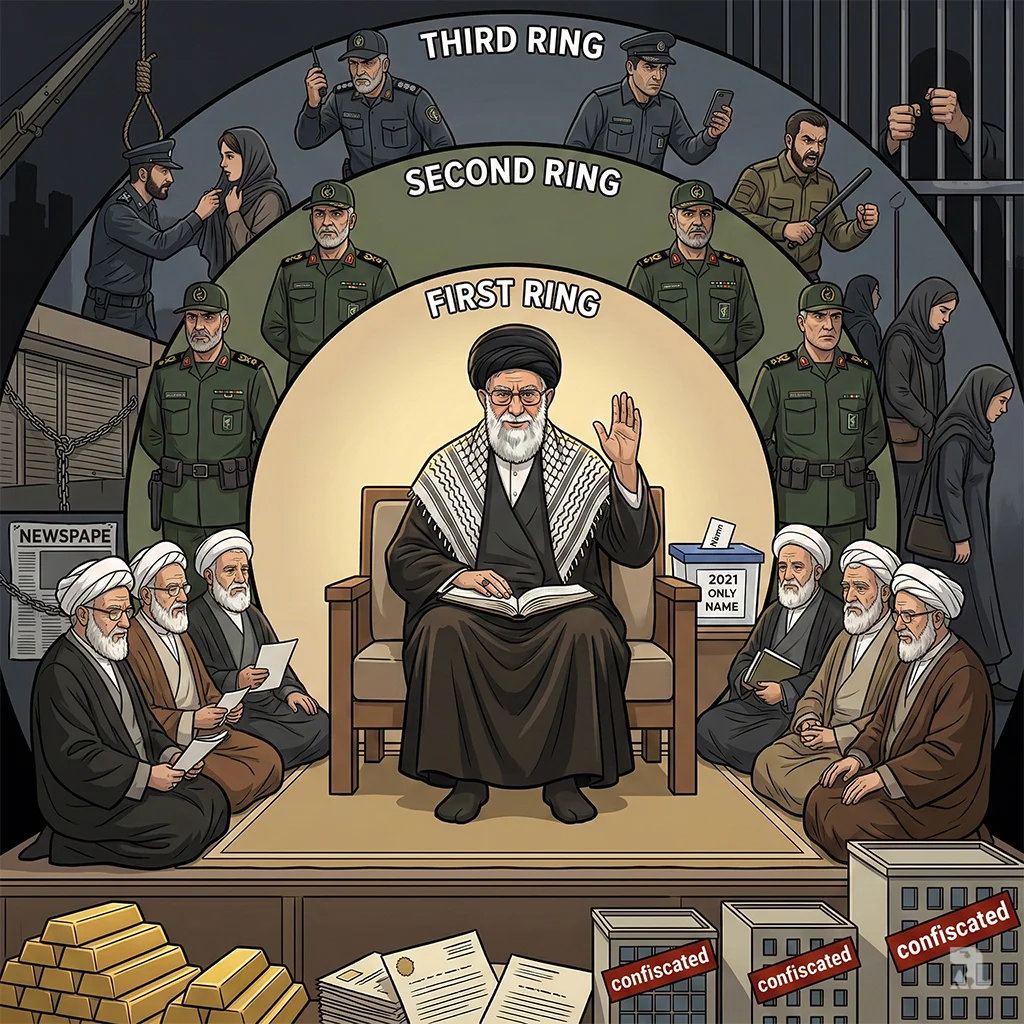
An illustration depicting the layered power structure under Ayatollah Khamenei. An older Khamenei sits on an elevated platform, surrounded by concentric rings of authority. The inner ring includes senior clerics. The next ring shows Islamic Revolutionary Guards Corps (IRGC) commanders. The outer ring depicts the tools of repression: morality police confronting a woman, Basij militiamen with batons, an imprisoned journalist, and an executioner's noose. Stacks of gold bars and seized property deeds are shown at the base of the platform.

As Supreme Leader, he ruled harshly, expanded the Revolutionary Guards, strengthened morality police and Basij, blocked reforms, jailed critics, enforced strict rules on women, and controlled a $95 billion empire built from seized properties.
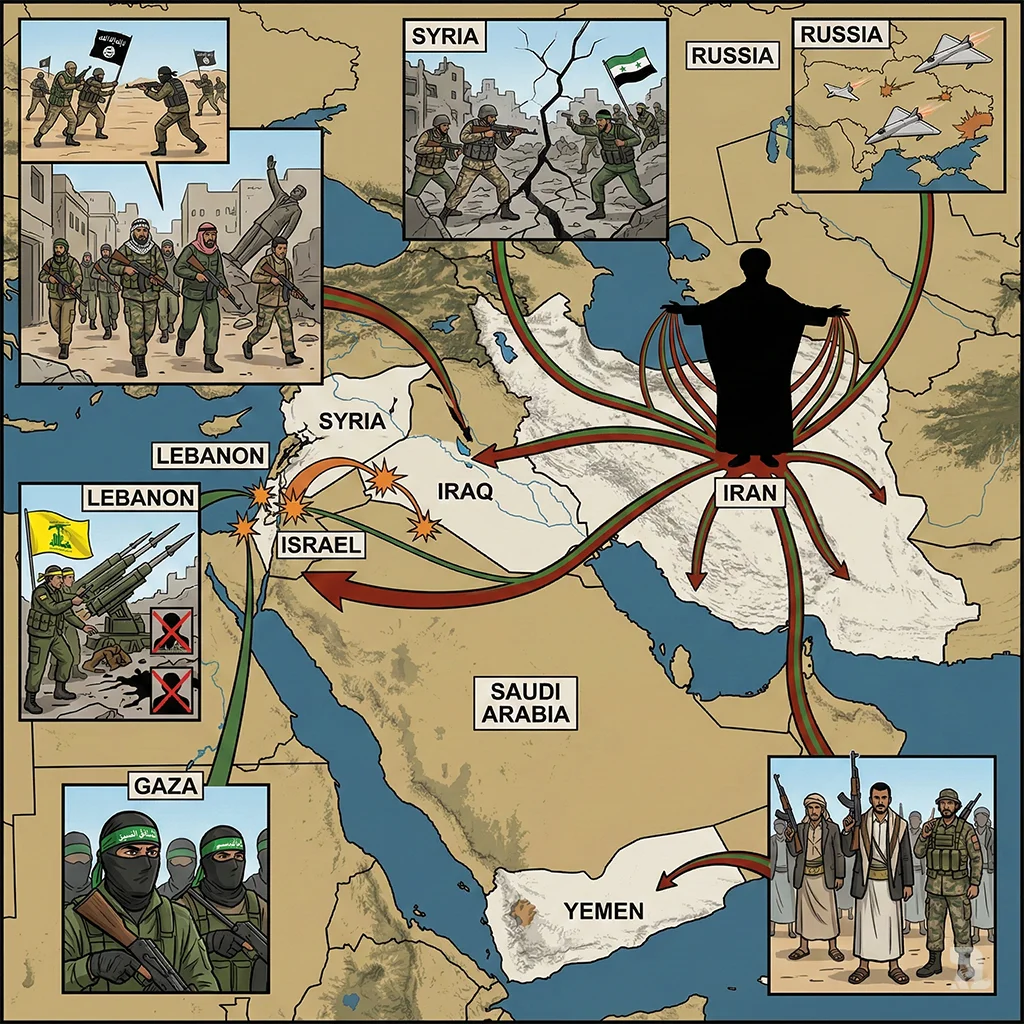
A strategic map of the Middle East with Iran at the center. Red arterial lines extend from Khamenei's silhouette to vignettes showing Iran's "Axis of Resistance": Shiite militias in Iraq, fighters in Syria (marked with a visual crack), Hezbollah forces in Lebanon, Hamas militants in Gaza, and Houthi fighters in Yemen. An inset shows Iranian Shahed drones being used in Ukraine. Missile trajectories are shown arcing toward Israel, and Saudi Arabia is depicted in a defensive posture.

He built an “Axis of Resistance”, arming militias in Iraq, Lebanon, Gaza, Yemen to threaten Israel and rival Saudi Arabia. He used the 2003 Iraq war, backed Syria, praised Hamas’s 2023 attack, and sent drones to Russia.
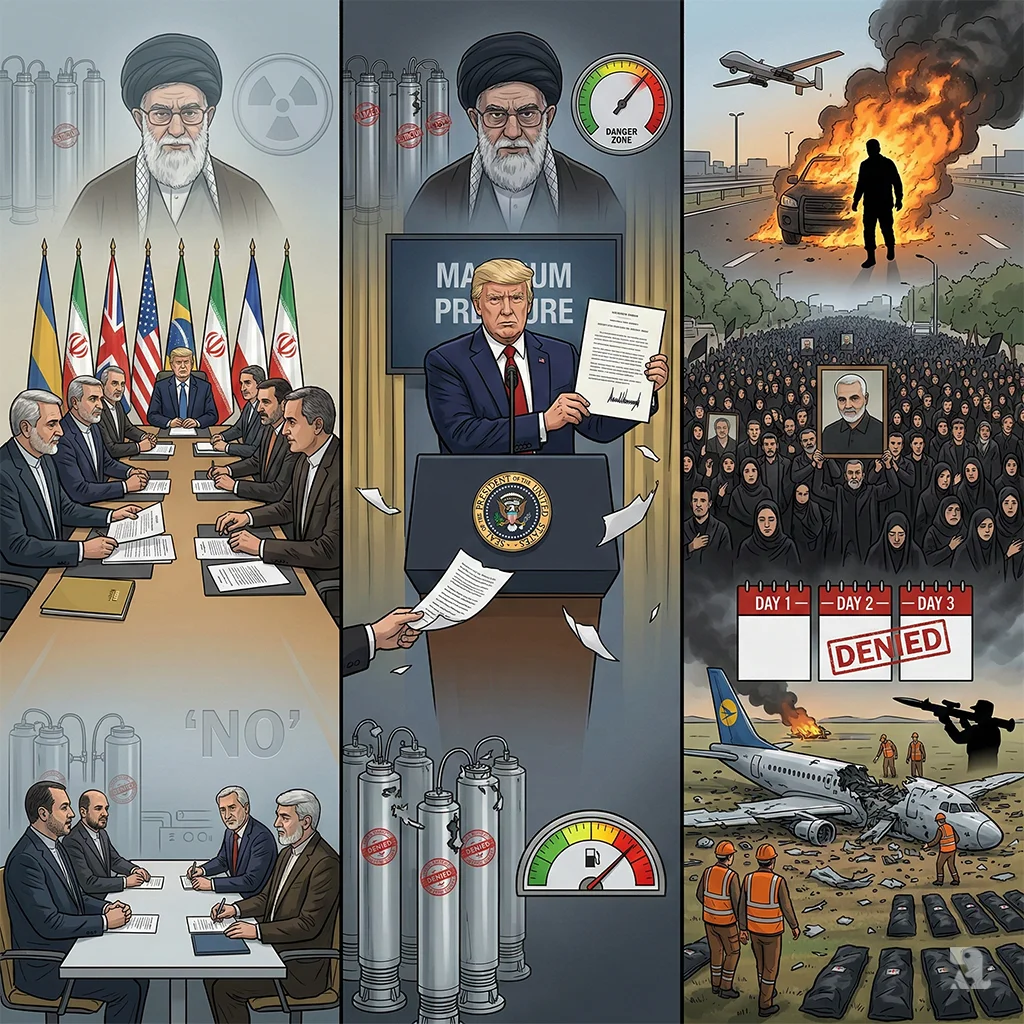
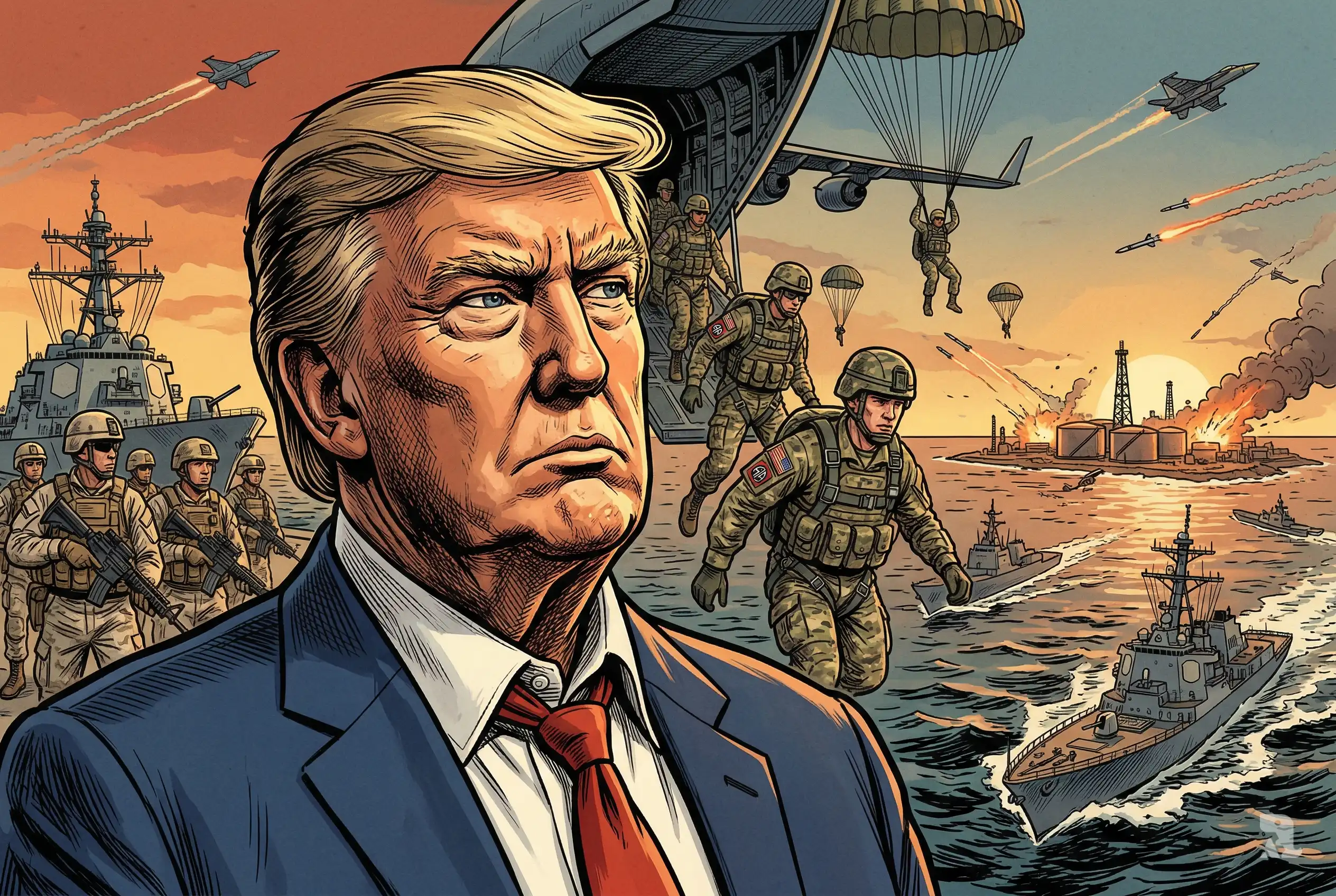
A three-part horizontal illustration tracing the collapse of diplomacy. On the left, Iranian and American diplomats sign the 2015 nuclear deal in Vienna. In the center, Donald Trump holds up the US withdrawal from the deal in 2018 as uranium enrichment resumes. On the right, the aftermath of the 2020 US killing of General Qassim Suleimani is shown alongside the wreckage of Ukrainian Airlines Flight 752, which was shot down by Iran's Revolutionary Guards, killing all 176 onboard.

He accepted the 2015 nuclear deal, but Trump’s 2018 withdrawal deepened mistrust. Iran resumed enrichment. In 2020, the US killed General Suleimani. Soon after, Iran shot down a Ukrainian jet, killing 176, denying it for 3 days.
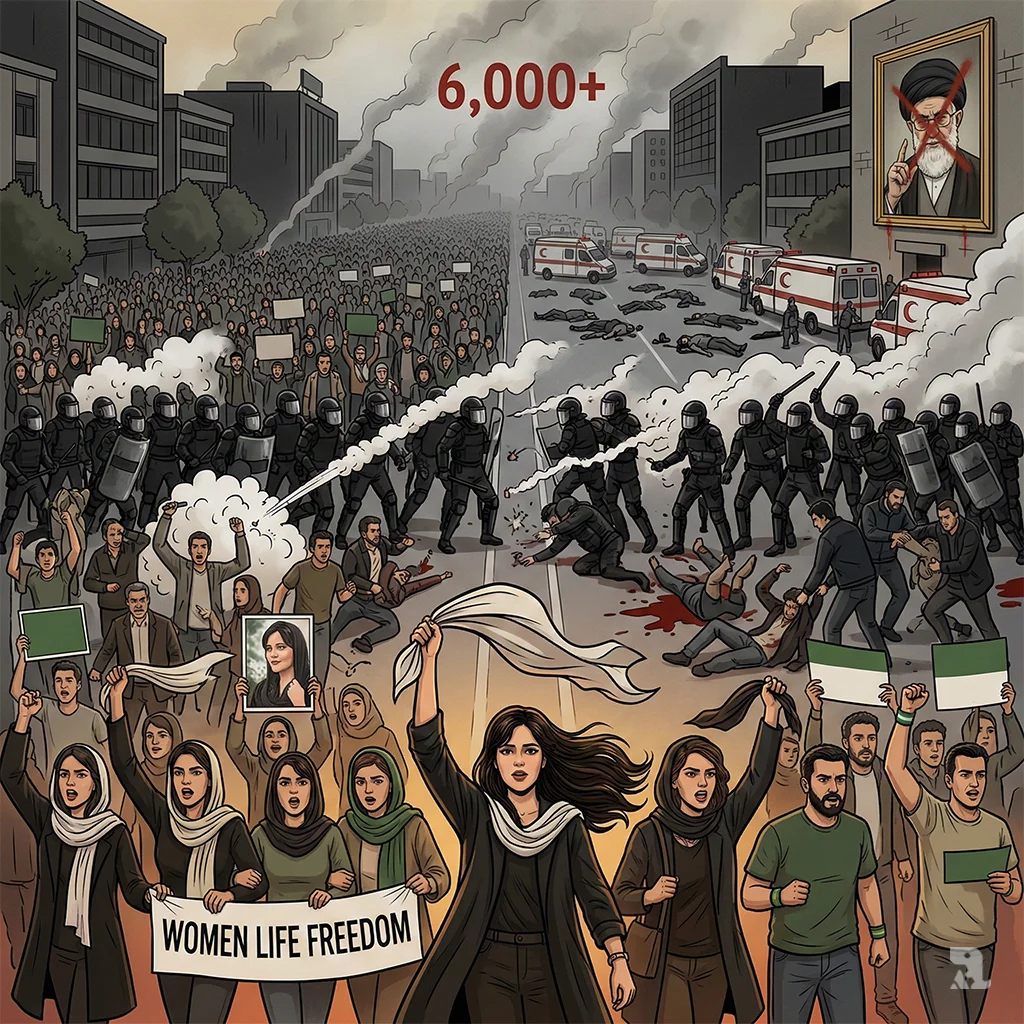
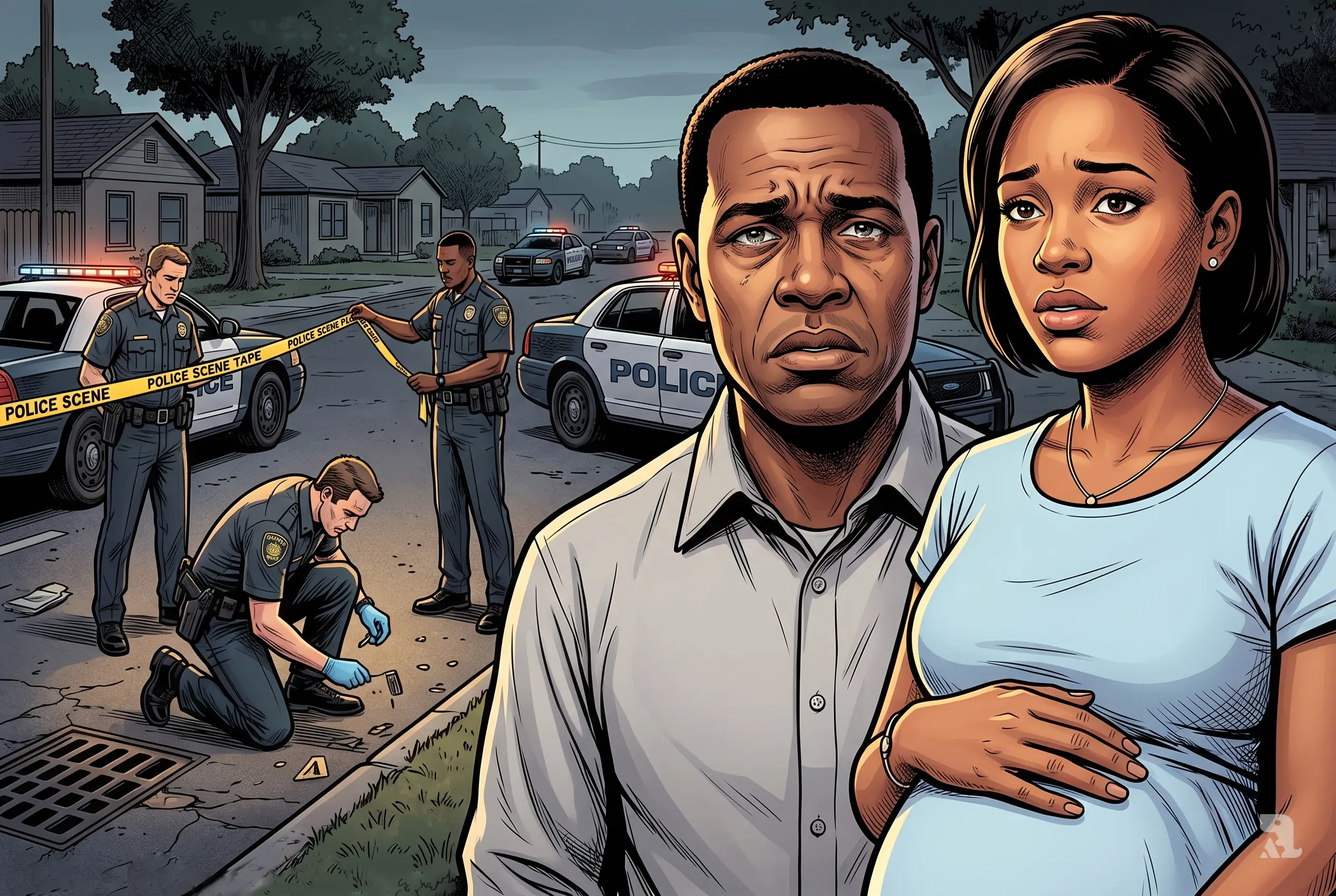
A wide-angle view of a massive protest in Tehran. In the foreground, women lead the march, defiantly removing and waving their headscarves, holding a "Woman Life Freedom" banner. In the midground, security forces in riot gear clash with protesters, firing tear gas. In the background, the scene turns to tragedy with bodies on the ground, representing the 2026 massacre. The number "6,000+" is visible in the smoke-filled sky, and a portrait of Khamenei is being defaced with spray paint.

Protests challenged him in 2009, after Mahsa Amini’s death in 2022, and again in 2026. Each time he ordered crackdowns. In 2026, forces opened fire, killing 6,000+ per rights groups. He blamed foreign enemies.
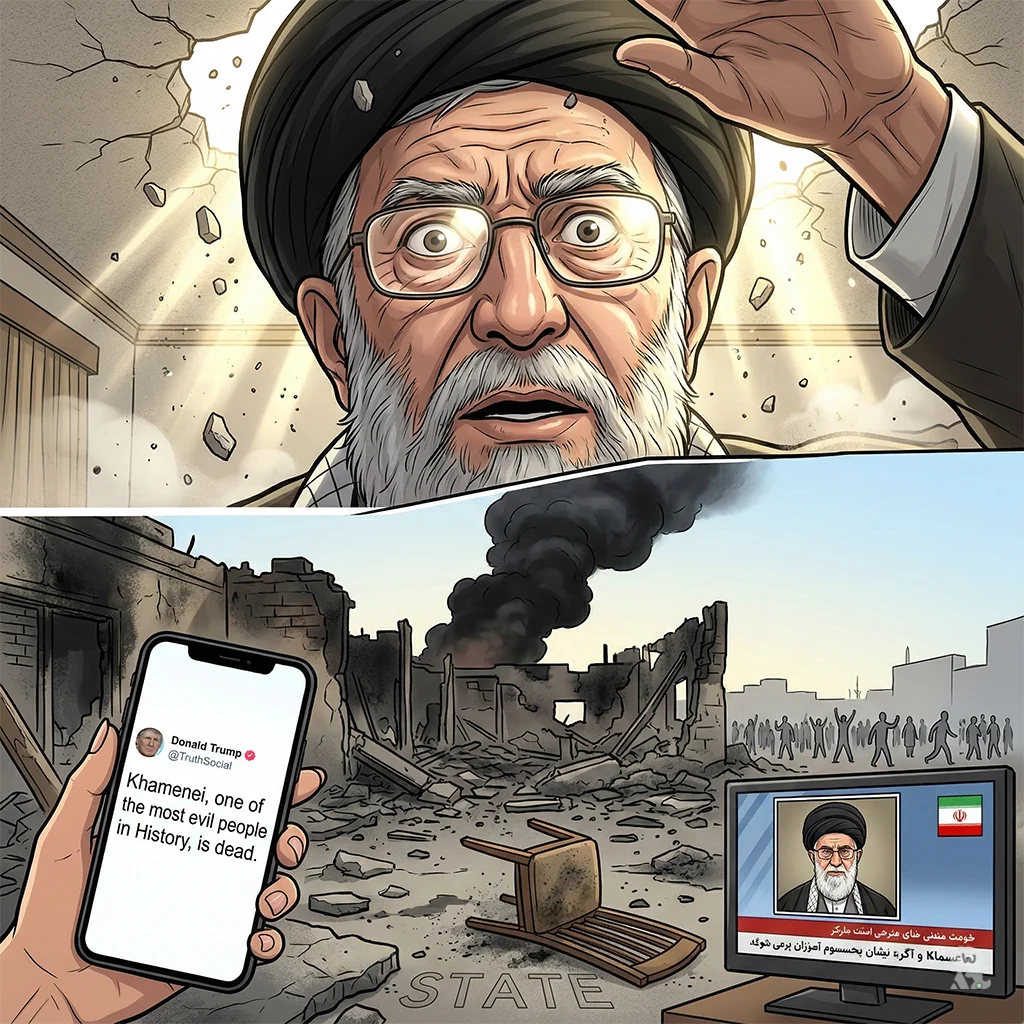
A split composition depicting the final moment and aftermath. The upper portion shows a tight close-up of an elderly Ayatollah Khamenei's face, eyes wide with shock as the ceiling above him cracks and light pours in from an incoming strike. The lower portion shows the destroyed Leadership House compound. In the foreground, a phone displays Donald Trump's Truth Social post announcing Khamenei's death, and an Iranian TV screen confirms it. In the distant background, tiny figures begin to gather in the streets. An overturned chair sits empty in the rubble.

On Saturday, US and Israeli strikes hit Iran. Trump posted that Khamenei was dead. Iranian state media confirmed it. After nearly 4 decades in power, the region’s longest-serving leader was gone. What happens next is unclear.
A quick visual update that saves you 10 minutes of reading – Source: The New York Times

Similar Posts